



GABA Receptor
Gamma-aminobutyric acid Receptor; γ-Aminobutyric acid Receptor
GABA receptors are a class of receptors that respond to the neurotransmitter gamma-aminobutyric acid (GABA), the chief inhibitory neurotransmitter in the vertebrate central nervous system. There are two classes of GABA receptors: GABAA and GABAB. GABAA receptors are ligand-gated ion channels (also known as ionotropic receptors), whereas GABAB receptors are G protein-coupled receptors (also known asmetabotropic receptors). It has long been recognized that the fast response of neurons to GABA that is blocked by bicuculline and picrotoxin is due to direct activation of an anion channel. This channel was subsequently termed the GABAA receptor. Fast-responding GABA receptors are members of family of Cys-loop ligand-gated ion channels. A slow response to GABA is mediated by GABAB receptors, originally defined on the basis of pharmacological properties.
All Product Categories
-
GABA Receptor Inhibitors
(151)
View all products
-
GABA Receptor Agonists
(188)
View all products
-
GABA Receptor Antagonists
(137)
View all products
-
GABA Receptor Activators
(75)
View all products
-
GABA Receptor Modulators
(92)
View all products
-
GABA Receptor Controls
(4)
View all products
-
GABA Receptor Ligands
(16)
View all products
-
GABA Receptor Related Products (781)
Related Products (781)

-
Antibodies (14)
-
Related Compound Screening Libraries (1)
-
Anticonvulsant agent 5
 0 ImagesCat. No.: HY-162757Anticonvulsant agent 5 (Compound 5c) exhibits high affinity for GABAA receptors and NaV1.3 receptors. Anticonvulsant agent 5 shows anticonvulsant efficacy in mice psychomotor epilepsy test with an ED50 of 107 mg/kg. Anticonvulsant agent 5 exhibits neuroprotective activity against Kainic acid (HY-N2309) with an IC50 of 113 μM. Anticonvulsant agent 5 is blood-brain barrier (BBB) penetrable.
-
Ro 15-1310
 0 ImagesCat. No.: HY-115854CAS No.: 78756-33-9Ro 15-1310 is an imidazobenzodiazepine that exhibits high affinity and selectivity for alpha 5-containing GABAA receptors. Ro 15-1310 is promising for research of convulsions.
-
Timelotem
 0 ImagesCat. No.: HY-160978CAS No.: 96306-34-2Synonyms: KC-7507 free baseTimelotem (KC-7507 free base) is a representative of a class of 1, 2-cyclo1, 4-benzodiazepines. Timelotem shows significant antipsychotic properties. Timelotem produces sedative, anti-anxiety and anti-convulsant effects by enhancing the action of the neurotransmitter gamma-aminobutyric acid (GABA). Timelotem can be used in studies of schizophrenia and other mental disorders.

-
GT-002
 0 ImagesCat. No.: HY-P992360GT-002 is a partial positive allosteric modulator targeting the α3 subtype of GABAA receptors, as well as a specific binder of tumor-associated TF-glycosylated LYPD3. GT-002 mildly enhances GABA-induced chloride currents by binding to the benzodiazepine site of GABAA receptors, thereby alleviating prefrontal hypofunction and improving cognitive, memory and social interaction abilities. GT-002 can be used in research related to schizophrenia spectrum disorders, various squamous cell carcinomas, colorectal cancer, non-small cell lung cancer, and aromatic L-amino acid decarboxylase deficiency.
-
(S)-Baclofen hydrochloride
 0 ImagesCat. No.: HY-B0007ACAS No.: 63701-56-4(S)-Baclofen hydrochloride is a GABAB receptor agonist that crosses the blood-brain barrier and is orally active, with IC50 values of 1.77 μM for GABAB and 1564 μM for GABAA. (S)-Baclofen hydrochloride can be used in research on muscle disorders such as spasticity.
-
(S)-3C4HPG
 0 ImagesCat. No.: HY-100842ACAS No.: 55136-48-6(S)-3C4HPG is a metabotropic glutamate receptor antagonist, demonstrating significant potential in modulating neuronal excitability and influencing synaptic transmission.
-
(-)-JM-1232
 0 ImagesCat. No.: HY-108035CAS No.: 1013427-48-9Synonyms: MR04A3(-)-JM-1232 (MR04A3) targets GABA A receptors and exerts its analgesic effects by binding to the benzodiazepine binding site of GABA A receptors. (-)-JM-1232 demonstrates potent analgesic effects in mice against acute thermal stimuli, mechanically induced pain, and visceral pain, with CI50 values of 2.96, 3.06, and 2.27 mg/kg, respectively. (-)-JM-1232 can be used in research related to pain and analgesia.
-
GABAA receptor agent 5
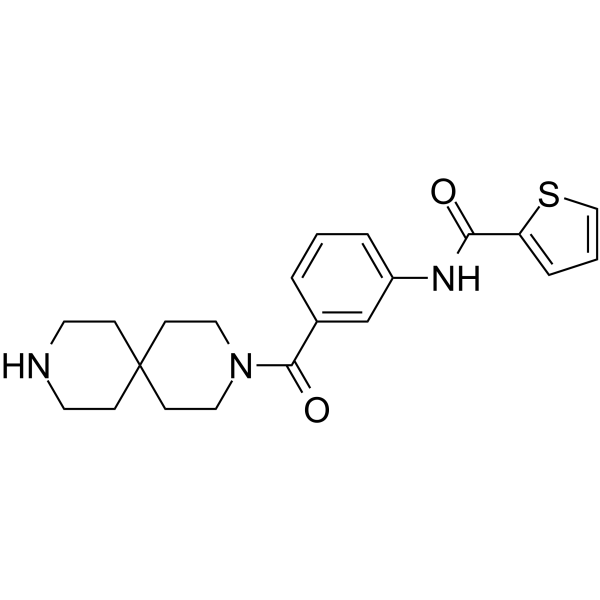 0 ImagesCat. No.: HY-145257CAS No.: 1808389-92-5GABAA receptor agent 5 (compound 018) is a potent γ-GABAAR antagonist with an Ki of 0.020 µM. GABAA receptor agent 5 shows γ-GABAAR antagonist activity with low cellular membrane permeability.
-
GABAA receptor modulator-12
 0 ImagesCat. No.: HY-W070739CAS No.: 6252-98-8GABAA receptor modulator-12 (Compound 5) is a GABAA receptor modulator. GABAA receptor modulator-12 inhibits anesthetic-induced desensitization of GABAA α3β3γ2 receptors with an IC50 of 0.2 μM. GABAA receptor modulator-12 can be used in the research of central nervous system disorders.
-
Pipazethate hydrochloride
 0 ImagesCat. No.: HY-W742300CAS No.: 6056-11-7Synonyms: SKF 70230A hydrochloride; SQ 15874 hydrochloride; Pipazetate hydrochloridePipazethate (SKF 70230A; SQ 15874) hydrochloride is a potent GABA antagonist. Pipazethate hydrochloride shows antitussive activity and can be used in research in cough suppressant .
-
Ro 17-1812
 0 ImagesCat. No.: HY-116944CAS No.: 90450-01-4Ro 17-1812 is a benzodiazepine receptor partial agonist with anticonvulsant effect.
-
SKF 97541
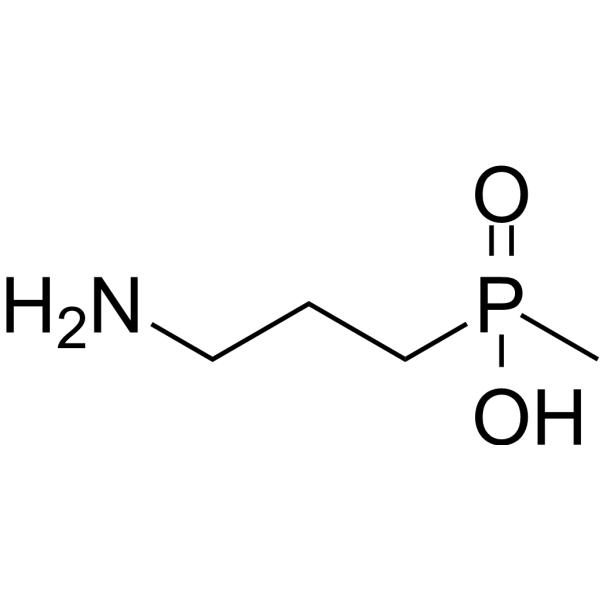 0 ImagesCat. No.: HY-100915CAS No.: 127729-35-5Synonyms: CGP 35024SKF 97541 (CGP 35024) is a potent and selective GABAB agonist that can induce hyperpotential. SKF 97541 has antiepileptic activity.
-
(Rac)-Acetoxyvalerenic acid
 0 ImagesCat. No.: HY-167702CAS No.: 81397-67-3(Rac)-Acetoxyvalerenic acid is a derivative of valerenic acid that acts as a GABA (A) receptor modulator, potentially providing sedative and sleep-enhancing effects. (Rac)-Acetoxyvalerenic acid exhibits slower permeability across the blood-brain barrier compared to diazepam, indicating that its transport may rely on an unidentified pathway rather than transcellular passive diffusion.
-
GABAA receptor agent 7
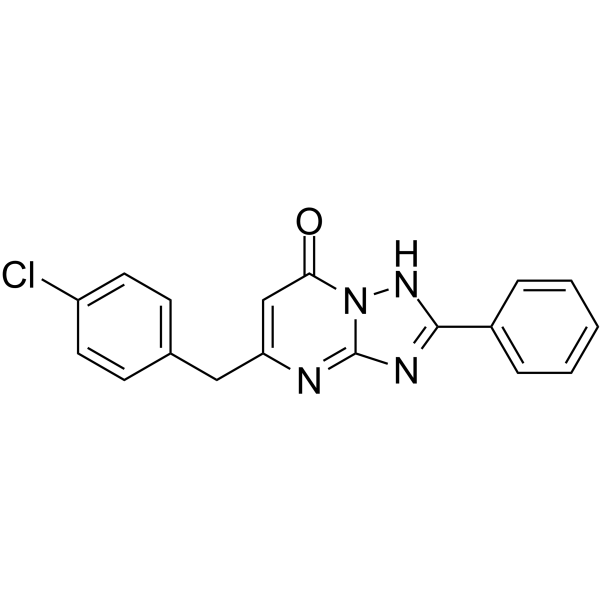 0 ImagesCat. No.: HY-146099CAS No.: 2376841-18-6GABAA receptor agent 7 (compoud 5c) is a potent GABAA receptor positive modulator. GABAA receptor agent 7 shows anticonvulsant activity in vitro and in vivo with low neurotoxicity. GABAA receptor agent 7 has the potential for the research of epilepsy.

-
mGAT3/4-IN-2
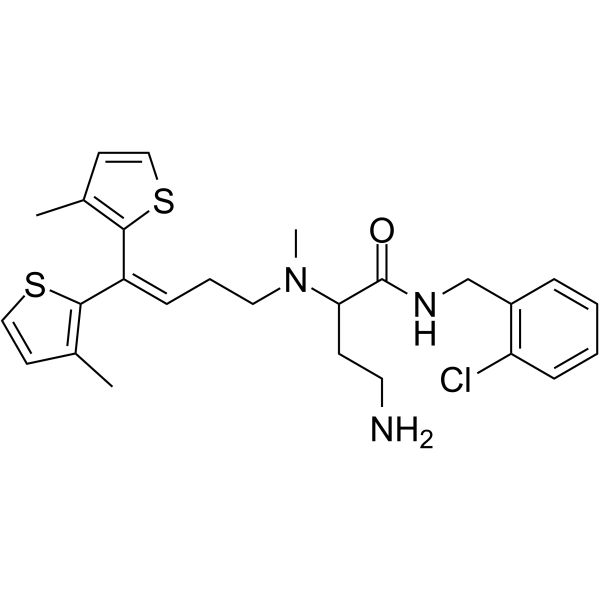 0 ImagesCat. No.: HY-146281CAS No.: 2556833-68-0mGAT3/4-IN-2 (compound 27b) is a potent mGAT3/mGAT4 inhibitor, with pIC50 values of 5.44 and 5.25, respectively.
-
Valerenic acid (Standard)
 0 ImagesCat. No.: HY-103524RCAS No.: 3569-10-6Synonyms: (-)-Valerenic Acid (Standard)Valerenic acid (Standard) is the analytical standard of Valerenic acid. This product is intended for research and analytical applications. Valerenic acid ((-)-Valerenic Acid), a sesquiterpenoid, is an orally active positive allosteric modulator of GABAA receptors. Valerenic acid is also a partial agonist of the 5-HT5a receptor. Valerenic acid mediates anxiolytic activity via GABAA receptors containing the β3 subunit. Valerenic acid also exhibits potent antioxidant properties.
-
IUN-00433
 0 ImagesCat. No.: HY-182511CAS No.: 2188230-70-6IUN-00433 (Compound 36) is a selective positive allosteric modulator of α4β1δ-type GABAA receptors, with an EC50 of 0.060 μM. IUN-00433 is applicable to research related to neurological disorders.
-
Thiazesim
 0 ImagesThiazesim is a CNS-penetrant GABAA receptor inhibitor, exerting anticonvulsant and antidepressant effects. Thiazesim depresses amygdala output, disrupts conditioned avoidance response in rats. Thiazesim can be used for the research of depression and epilepsy.




